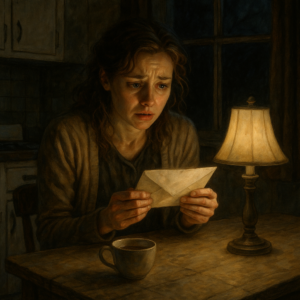
The tea in my cup had gone cold before Mark finally sat down, and even then he only perched on the edge of the chair like he had somewhere better to be. It was a Tuesday afternoon in October, the kind where the light through my window at Fairview Manor turns everything the color of weak coffee. I remember thinking the fake ficus by my bed needed dusting again.
“Mom,” he said, “I need to talk to you about the payments here.”
I set my cup down on the little tray table. “Go ahead.”
He rubbed his jaw the way he does when he’s rehearsed something and it still doesn’t come out right. “The business had a rough quarter. A couple of contracts fell through. I can’t keep covering the full monthly rate at Fairview.”
I looked at him a long moment. Mark is forty-three, owns a small trucking and logistics outfit outside Millbrook, wears a watch that costs more than my first car did. He gets that flat, managing tone from somewhere, and I suppose part of that somewhere is me. I taught him not to panic. I never taught him that some debts aren’t the kind you can restructure.
“So you’re moving me,” I said. Not a question.
“There’s a state-assisted facility over in Denton. It’s not bad, Mom. I looked into it.”
“You looked into it.”
He didn’t answer that. He checked his watch instead, and something in me went very quiet and very still, the way a kitchen goes quiet after the timer finally stops.
I raised him alone after his father left when Mark was seven, took off with a woman from the parts store and never sent much beyond a card at Christmas. I cleaned houses on Tuesdays and Thursdays, worked the deli counter the rest of the week, and did alterations at night on a machine that jammed if you looked at it wrong. I sold my mother’s wedding ring so he could start college without loans. When his trucking company nearly folded twelve years back, I sat at my own kitchen table and signed a personal guarantee on his business loan at Millbrook Trust, because he sat across from me with his hands shaking and said, “Mom, if I lose this, I lose everything.”
I never told him I’d kept the paperwork. I never told him because there was no reason to, not until there was.
He left that day after a stiff hug and a promise to “figure something out.” I didn’t cry until the door clicked shut, and even then, not for long. I opened my nightstand drawer, the one with the photo of Mark at his eighth-grade graduation and a stack of old birthday cards, and underneath all of it, the folder.
The bank officer who’d handled the loan back then, a serious young man named Gary Pruitt, had told me, “Mrs. Whitfield, don’t sign something like this and then forget it’s out there.” I hadn’t forgotten. I’d just hoped I’d never need to remember.
I called Nina the next morning. She’s eighty, was a business attorney for thirty years before she retired to raise dahlias and terrorize the bridge club. “Well,” she said when she picked up, “if it isn’t the woman who only calls when something’s on fire.”
I told her everything, start to finish, including the watch.
She was quiet a second. “You still have the guarantee documents?”
“Every page.”
“Bring them by the office. I want to see the covenant language before we talk about what you can do.”
Two days later my niece Patty drove me over, because my hands don’t do well on the highway anymore. Nina spread the papers across her desk and tapped one page with a red fingernail. “Here. If you formally withdraw as guarantor, the bank can call the loan for review. Given his numbers lately, I doubt they’d wait long.”
“So the business could go under.”
“It could.” She looked at me over her glasses. “You understand what you’re holding.”
I did. It didn’t feel like power exactly. It felt like standing at the edge of something I never asked to stand at.
Three days after that, Patty drove me to Mark’s house, the big brick one on Alder Court with the three-car garage and the kitchen island his wife Renee picked out of a magazine. Renee was at work. Mark opened the door already frowning, like my visit was an inconvenience he hadn’t scheduled.
“Mom? What’s going on?”
I didn’t answer. I set the folder on his marble countertop and slid the top page toward him.
He read it once fast, then slower, then went back to the top like the words might rearrange themselves into something easier. The color left his face the way it does when a person realizes the ground under them was never quite theirs.
“You guaranteed the original loan,” he said. It wasn’t a question either.
“Twelve years ago. At my kitchen table. You remember the kitchen table.”
He sat down hard on one of his own barstools. “If you pull this—”
“The bank reviews the loan. Today, if I want.”
He put both hands over his face. “There are thirty people on my payroll, Mom. Drivers. Dispatchers. People with kids.”
“I know.”
“Please.” He came around the island toward me, and for one second he looked exactly like he did at nine years old, the time he broke the neighbor’s window and came running to me before he even ran to his room. “Please don’t do this.”
I stepped back before he could take my hand. “Now you know what it feels like to have your whole life depend on someone else’s decision.”
He cried then, quietly, the way men do when they’ve forgotten how. I let him.
I told him I wasn’t there to ruin him. I told him I was there because he’d forgotten who built the floor he was standing on. Nina had drawn up a second paper too — full resumption of my care payments, a move to a private place of my own choosing, a repayment schedule for everything he’d borrowed over the years, with interest low enough to be fair and high enough to mean something.
“And one more thing,” I said. “You don’t buy my forgiveness with a signature. You earn it by showing up.”
He signed two weeks later, after his own lawyer reviewed it line by line, no shortcuts.
It’s been four months. I live now at a place called Cedar Grove, with a little garden out back and good soup and a window that catches the afternoon sun properly. Mark visits Thursdays, sometimes Sundays too. He brought flowers and bakery boxes the first few times, like a man trying to buy his way past something. I sent the pastries home untouched. He stopped bringing gifts after that and started just sitting with me, reading me the county paper when my eyes get tired.
Last week he said, “I don’t know when I turned into somebody who’d do that.”
“Little by little,” I told him. “That’s how most of it happens.”
I don’t know if I’ve forgiven him all the way. I know the account Nina helped me open, in my name only, has the first repayment in it, and I told Mark I intend to spend some of it on something foolish and pretty, just because I never got the chance. He laughed. Then he got quiet, and looked out at the garden instead of at me, the way his father used to when he didn’t want to say the true thing out loud.