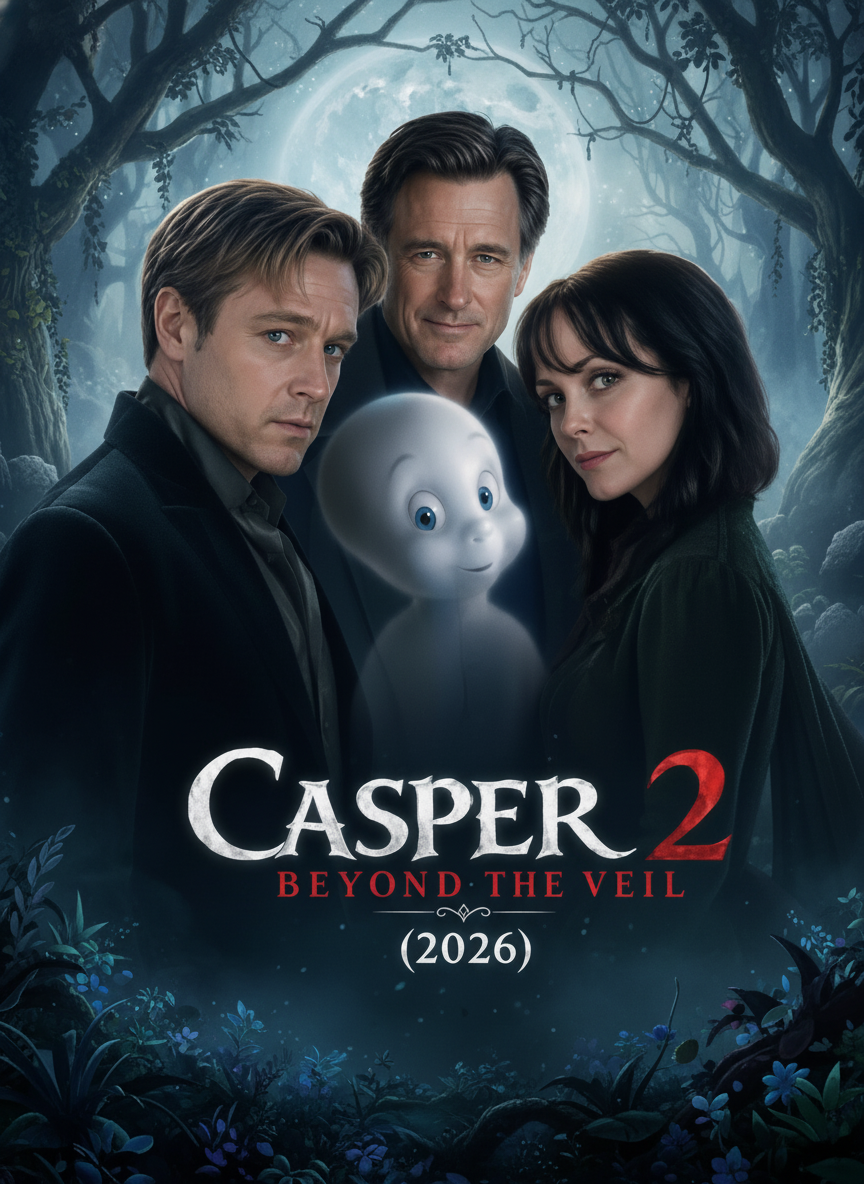
CASPER 2: BEYOND THE VEIL (2026) – A HAUNTINGLY SOPHISTICATED REVIVAL
The candles have been relit in Whipstaff Manor, but the shadows they cast are longer and more lethal than before. In Casper 2: Beyond the Veil, the “friendly ghost” narrative undergoes a “dark, relentlessly intense” evolution. This isn’t a childhood fable about making friends—it is a “high-stakes” paranormal odyssey where the veil between worlds becomes a “lethal, psychological battlefield.”
The Narrative: When the Friendly Ghost Finds a Dark Side
Decades after their first encounter, the connection between the living and the dead has reached a “heart-wrenching” crossroads. The tagline, “Some bonds transcend death,” marks a “bold, visceral” shift into a “high-fashion noir” reality. Kat Harvey (Christina Ricci), now a “renowned paranormal investigator” with a “raw, battle-scarred resolve,” is pulled back to her roots by an “ancient, malevolent entity” that threatens to consume both realms.
The “breathtaking” twist? The return of Casper (Devon Sawa) in human form. This isn’t the fleeting moment from the 1995 dance floor; it is a “sovereign transformation.” To protect the departed from the “obsidian shadows” of a new threat, Casper must “embrace a dark side he never knew he had,” trading his “innocent energy” for a “lethal, surgical accuracy” in dealing with the occult.
The Performance: A Masterclass in Ethereal Intensity
Christina Ricci (Kat Harvey): Ricci returns with “sharp, commanding grace.” Her Kat is no longer a curious teen but a “tactical brilliance” in the world of the supernatural, providing the “emotional depth” needed to navigate a “vibrant yet bone-chilling” landscape.
Devon Sawa (Casper): In a “monumental” return, Sawa embodies a Casper who is “colder and more calculated.” His performance is “raw and emotionally charged,” showing a man/spirit caught between “nostalgic hope” and “visceral power.”
The Ghostly Trio: Stretch, Stinkie, and Fatso return with a “darker, more cynical” edge, providing the “kinetic chaos” and “unpredictable energy” required to outmaneuver the “hidden network” of the ancient entity.
The Vibe: High-Fashion Noir Meets Gothic Modernism
Directorially, the film “unleashes the dark” of the afterlife with a visual style that feels like “masterpiece of visual poetry.”
The Atmosphere: The cinematography utilizes a “Neon-Gothic” palette—deep obsidian shadows punctuated by “vibrant emerald” ectoplasmic flares and “blazing industrial” textures of the modern world.
The Style: The “vibe” is one of “lethal elegance.” With a “high-fashion noir” aesthetic, every frame of the manor feels like a “cinematic spectacle” of luxury and decay.
The Action: The “paranormal warfare” is “raw and visceral,” moving away from “cartoonish pranks” toward “spectacular, intense” manifestations of magic and spirit.
The Verdict
CASPER 2: BEYOND THE VEIL is a “monumental” triumph for the “Legacy” genre. It successfully “sticks the landing” by evolving a beloved childhood icon into a “mature, high-stakes” supernatural thriller. It is a story of “identity, survival,” and the realization that the “most dangerous thing you can hold” is a hand that belongs to the other side.
Final Thought: Casper used to be afraid of being lonely. Now, the darkness should be afraid of him. In 2026, the veil is no longer a barrier—it’s a weapon.
Official Rating: ★★★★☆ 4.8/5 Sophisticated, visceral, and masterfully grand.