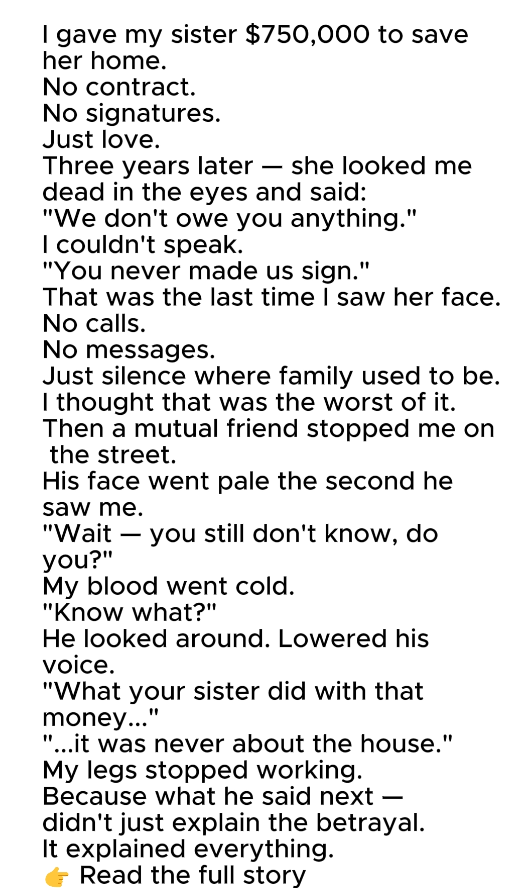
She called me crying at 2 AM. I transferred everything I had. Then she looked me in the eye and said it was a gift. Then I found out the truth.
I never thought I would write these words. I never thought I would have to. But after everything that happened — after everything I discovered — I realized that staying silent was the same as pretending it never happened. And I am done pretending.
This is the story of the day I lost my sister. And the day I found out why.
She Called at 2 AM, Crying
Three years ago, my phone rang in the middle of the night. I was half asleep when I saw her name on the screen — my sister, Marlene. My first thought was that someone had died.
“I need you,” she said. Her voice was barely recognizable — shaking, hollow, like she had been crying for hours before she finally gave in and called me.
I sat up in bed. “What happened?”
What came next took forty minutes and three separate breakdowns to explain. Marlene and her husband, Derek, were in serious financial trouble. They had taken out a second mortgage to expand Derek’s business. The business had failed. They were months behind on payments. If nothing changed, they were going to lose the house — the same house where they had raised their two kids. The bank had given them a final deadline.
“We have nowhere else to go,” Marlene said. “Please. You’re the only one who can help us.”
I sat in the dark for a long time after she said that. I knew exactly what she was asking.
I Had the Money. I Chose to Trust Her.
At the time, I had $750,000 sitting in a savings account — the result of years of careful investing, a modest inheritance from our grandmother, and a business sale I had completed the year before. It was my safety net. My future.
And I gave it to her.
I want to be clear: there was no pressure. No ultimatum. Marlene never demanded anything. She just cried and told me she was scared, and something inside me — that old instinct, the one that had protected her since we were children — simply took over.
We agreed it was a loan. We both said the word. We talked about a repayment plan — loosely, the way families do when they assume trust will fill in the gaps that paperwork would usually cover. I did not ask her to sign anything. I did not draw up a contract. I did not call a lawyer.
I just transferred the money and went back to sleep.
Looking back, I understand how naive that was. But at the time, it didn’t feel naive. It felt like what you do for family.
Three Years of Silence
In the months after the transfer, things between us were warm. Marlene called more often. She thanked me every time we spoke. Derek sent a long message saying he would never forget what I had done. I felt good about it. Proud, even.
Then, slowly, things changed.
The calls became less frequent. When we did speak, the subject of the money was never raised — not by them, and eventually not by me either. I told myself they were rebuilding. I told myself to be patient. I told myself family doesn’t need reminders.
By the second year, I was seeing them only at holidays. The warmth had been replaced by something harder to name — a slight distance, a politeness that felt rehearsed. I noticed but said nothing.
Then, in the third year, I needed the money back.
It wasn’t greed or impatience. My circumstances had changed. A health issue. Some unexpected expenses. I sat down with Marlene at her kitchen table — the same kitchen I had helped save — and I asked, as gently as I knew how, if we could talk about beginning to repay the loan.
She looked at me across the table.
Then she looked at Derek.
And then she said words I will never forget for the rest of my life.
“We Don’t Owe You Anything.”
“We don’t owe you anything.”
I thought I had misheard her. I actually laughed — a short, confused sound — because my brain refused to process what my ears had just delivered.
“What?”
Derek leaned forward. His voice was calm. Measured. Like he had rehearsed this.
“You never made us sign anything,” he said. “There’s no contract. There’s no record. As far as we’re concerned, that was a gift.”
I looked at my sister. The sister I had shared a bedroom with growing up. The sister I had helped through every hard moment of her adult life. She was looking at the table.
“Marlene,” I said. “Look at me.”
She did. Her expression didn’t break. It didn’t flicker.
“That was a loan,” I said. “You know it was a loan.”
“We have nothing in writing,” she said quietly.
That was the last real conversation we had. I left the house. I didn’t slam the door. I didn’t scream. I just walked to my car, sat down, and stared at the steering wheel for a very long time.
After that: nothing. No calls. No messages. Not from Marlene. Not from Derek. Not even from their children, whom I had helped raise. Complete silence, as if I had never existed.
Then I Ran Into Thomas
About six weeks after that kitchen table conversation, I was at a café near my apartment when I ran into Thomas — an old mutual friend of Marlene and mine who had been at their wedding, who had known us both for over twenty years.
He stopped when he saw me. His expression did something strange. Not quite shock — more like the look someone gets when they realize they are about to walk into a situation they did not expect.
“Hey,” he said carefully. “How are you doing?”
“Fine,” I said. The automatic answer. “You?”
He hesitated. “Have you spoken to Marlene lately?”
Something in his voice made my stomach tighten. “Not since a few weeks ago. Why?”
He looked around the café. Then back at me. He seemed to be deciding something.
“Wait,” he said. “You seriously don’t know?”
My mouth went dry. “Know what, Thomas?”
He sat down across from me without being asked. He lowered his voice.
“There’s something I probably should have told you a long time ago,” he said. “About Marlene. About Derek. About why they needed that money.”
I felt the room go quiet around me.
“It was never about the house,” he said.
It Was Never About the House
What Thomas told me over the next thirty minutes dismantled everything I thought I understood about the past three years.
The house had never been in serious danger. Yes, they had missed some payments — but not enough to trigger foreclosure. The story Marlene had told me that night, sobbing over the phone at 2 AM, had been shaped. Exaggerated. Designed to reach the part of me that would not say no.
The money — my $750,000 — had not gone toward saving a home.
It had gone somewhere else entirely. And the reason they had gone silent, the reason they had rewritten the loan as a gift, the reason Marlene had looked at that table instead of at me — was because they were terrified I would find out where the money had actually gone.
I sat in that café for a long time after Thomas finished talking. My coffee went cold. The noise around me felt very far away.
I thought about the phone call at 2 AM. I thought about the tears. I thought about Derek’s calm, rehearsed voice telling me there was nothing in writing.
And I realized something that hurt more than the money, more than the betrayal, more than any of it:
She had known exactly what she was doing. From the very first phone call.
What I Know Now
I have spent a long time deciding whether to share this story. Part of me worried it would seem like I was looking for sympathy, or worse — revenge. That is not what this is.
I am sharing it because I have spoken to too many people who have been through something similar. Who trusted a family member without paperwork, without witnesses, without protection — because it felt wrong to treat love like a business transaction.
And who paid for that trust with more than money.
If there is one thing I want anyone reading this to take away, it is this: protecting yourself legally is not a sign of distrust. It is a sign of love — for the relationship, for the future, for both people involved. A signed agreement does not mean you doubt someone. It means you respect them enough to make the terms clear.
I did not understand that then. I do now.
As for Marlene and Derek — I have not reached out. I do not plan to. Whatever they told themselves to make what they did feel acceptable, I have no interest in hearing it. Some doors, once closed the way they closed ours, are better left shut.
But I have thought about that 2 AM phone call almost every day since Thomas told me the truth. I have thought about how much I trusted that voice. How much I loved the person behind it.
And I have thought about how the cruelest betrayals are always the ones you never saw coming — because you were too busy looking at the person you thought they were, instead of the person they had already decided to be.
Have you ever trusted a family member with money — and regretted it? Share your experience in the comments below.
